Back to School Checklist for Solo-Parent Households
The back-to-school jobs that actually matter, in order: sort the admin with deadlines first (wraparound care places, free school meals registration, any clothing help your council or nation offers), buy shoes and the non-branded uniform second, leave stationery and the bag until the week before, and start shifting bedtimes about ten days out. Everything else is optional. If you do nothing but those four things, September works.
The order matters when you’re solo because nobody else is holding a piece of it — there’s no second adult who “did the school shoes” while you did the forms. So this list is sequenced by what bites you if it’s late, not by what’s most satisfying to tick off.
Three weeks out: the admin with deadlines
This is the bit that costs real money or real stress when it slips, and it’s the bit that gets left because it isn’t shopping.
- Book wraparound care. Breakfast club and after-school club places go early and go fast, and in most schools you can’t just turn up in September. If you work, this is the single most important item on the page.
- Check the term dates and inset days against your own work calendar now, while you can still swap shifts. Inset days in the first week are a classic ambush.
- Update your contact details and emergency contacts with the school office, especially if anything has changed at home this year. Two working numbers, at least one that isn’t you.
- Sort the school payment app. Dinner money, trips and clubs usually run through one system, and being locked out on day one is a specific misery.
- Confirm the school run. Bus pass, walking route, or the parent you’ve swapped with — agree it before term, not in the last week of August.
Money help worth checking before you buy anything
Do this before you spend, because some of it changes what you need to buy at all.
- Register for free school meals if you’re eligible, using the gov.uk free school meals page or your council’s form. Worth doing even if your child is in an infant year that gets meals automatically — the registration unlocks additional funding and, at many schools, help with trips and kit.
- Check for school clothing help. Scotland, Wales and Northern Ireland run national clothing-grant schemes; in England it varies by council and some don’t offer one at all. Start at gov.uk’s page on school clothing costs and then check your own council.
- Ask the school directly. Most have a hardship fund, a uniform swap, or a stock of second-hand items, and none of them advertise it. One quiet email to the office is not a confession, it’s admin.
- Check what the uniform policy actually requires. Schools in England are expected to keep branded items to a minimum and make uniform affordable, so if the list is heavy on logos, it’s entirely reasonable to ask which pieces genuinely need the crest and which can come from a supermarket.
The kit list, and when to buy each bit
Buy in this order, because the deadlines and the sale timings differ.
Now: shoes. They take the longest to get right and they’re the item where cheap genuinely costs more, because a pair that gives up in October has to be replaced in October. Get feet measured properly, buy from a brand that does width fittings — Clarks is the obvious canonical choice and holds up — and buy one pair that fits rather than two pairs that nearly do. Expect to pay somewhere around £35–£50 (~$46–$65) for something that lasts a full year of playgrounds.
Now: the non-branded uniform. Trousers, skirts, polos, shirts, PE kit. Supermarket multipacks are the sensible default and the ranges appear in late summer. Buy slightly big for growth on tops, exactly right on trousers, and always more socks than seems reasonable.
Now-ish: branded items, second-hand first. School logo jumpers and PE tops are the expensive bit, so try the school’s own second-hand rail, the PTA sale or a parents’ group before the official supplier. Most branded items are worn twice a week and outgrown, not worn out.
Week before: bags, water bottles, lunch boxes. Only replace what’s actually broken. Last year’s bag with a scrub usually has another year in it.
Week before: stationery. Buy the list the school gives you, not the aisle. Pencil cases are where good budgeting goes to die.
Label everything. Sharpie on the care label is free and works. Nothing comes home otherwise.
Getting sleep back before day one
Ten days out, start moving bedtime and wake-up earlier by about fifteen minutes every couple of days, rather than doing it all on the Sunday night before term. A six-week summer drift can’t be undone in one evening, and trying makes for a child lying awake, furious, and an adult sitting on the stairs.
Two things that help more than the timings themselves: get daylight into them early in the morning, which is what actually shifts a body clock, and put the last week’s evenings back into the old sequence — tea, bath, story, bed, in that order, at roughly the old times. The routine cues the sleep, not the clock.
The week before: a dry run
One quiet weekday morning, do the whole thing for real. Everyone up at the term-time time, dressed in the actual uniform, shoes on, out of the door, and walk or drive the route.
You’ll find out three things you’d otherwise discover on the first morning: whether the shoes fit, how long the route takes with the slowest child, and which bit of the morning is the bottleneck. It’s rarely what you think — here it was hair, every time.
While you’re at it, do a test lunchbox. A new box, a new water bottle and a new lunch on day one is three unknowns at once, and if yours is picky about food, my lunchbox ideas for picky eaters is a list of things that come home empty rather than admired.
The first morning, and the bag by the door
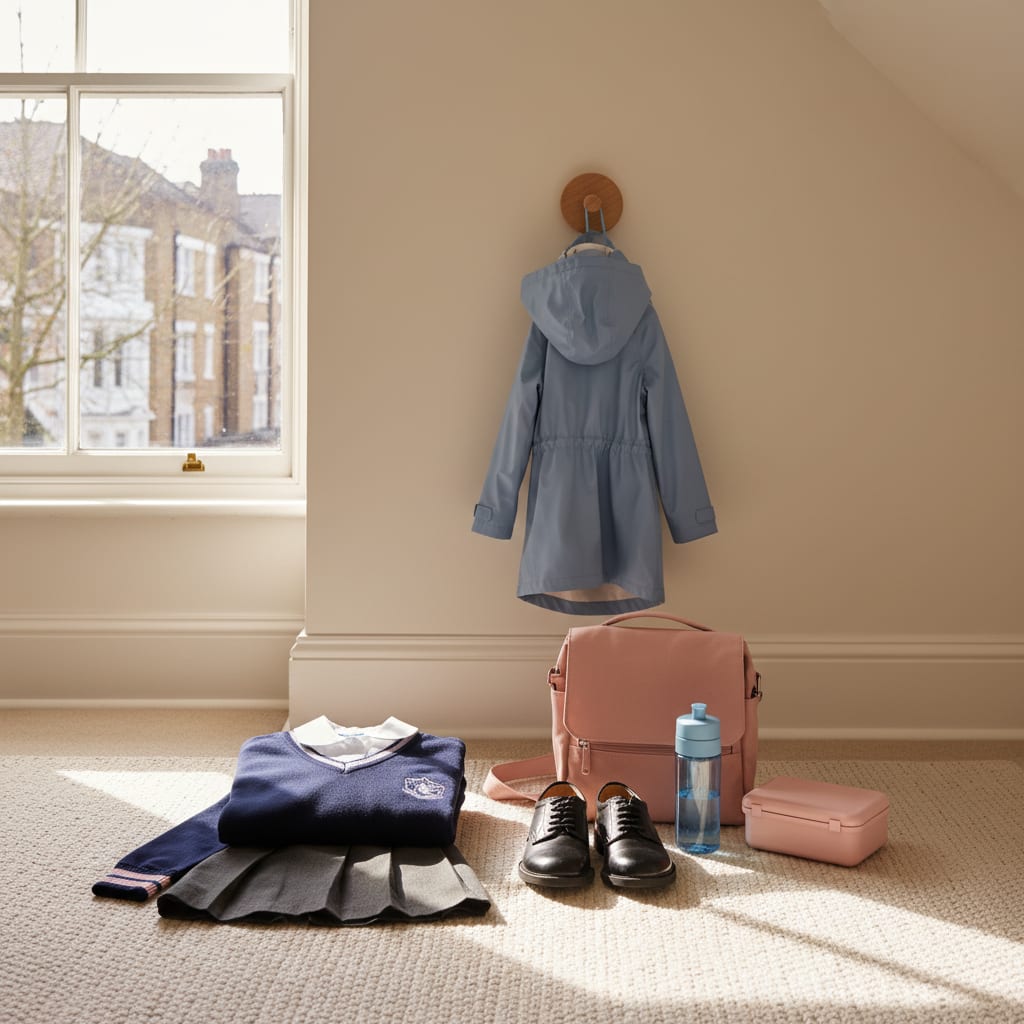
The night before, put everything by the front door: bag packed, uniform out, shoes together, water bottle filled in the fridge, PE kit in if it’s a PE day. Morning decisions are the enemy.
Then plan for the crash. The first week back is exhausting in a way that has nothing to do with schoolwork, and the fallout arrives at pick-up rather than at school — which is exactly what after-school snacks exist to absorb. Keep the first fortnight’s evenings deliberately empty. No clubs, no playdates, no ambitious cooking.
And put the costume dates in your calendar now, while you’re organised. World Book Day arrives every year with the same fake surprise, and having last year’s World Book Day costume ideas already bookmarked is a gift to your February self.
FAQ
What do I actually need to buy for back to school?
Shoes that fit properly, enough uniform for the week between washes, PE kit, a bag, a water bottle, a lunch box if they take a packed lunch, and whatever stationery the school specifically asks for. Everything else — new pencil cases, character bags, a second coat — is optional, and most of it can wait until something wears out.
When should I start getting bedtimes back to normal?
About ten days before term, moving bedtime and morning wake-up earlier in fifteen-minute steps every second day. Earlier morning light does more of the work than an earlier bedtime does, so open the curtains and get them outside in the morning while you’re shifting the evenings.
What help is there with school uniform costs in the UK?
Scotland, Wales and Northern Ireland have national school clothing grants; in England it depends on your council and many no longer offer one. Beyond that, schools themselves often run second-hand rails, swap shops and hardship funds. Check gov.uk, then your council, then ask the school office directly — the last one is the least advertised and often the fastest.
How do I manage the first week on my own?
Keep it deliberately dull. Nothing in the diary after school for the first fortnight, easy food you know they’ll eat, early bedtimes, and no expectation that anyone will be pleasant company by Thursday. The first week back is a huge adjustment for children, and the version of it that goes best is the one with the least in it.