School Shoes That Last: What's Worth the Money
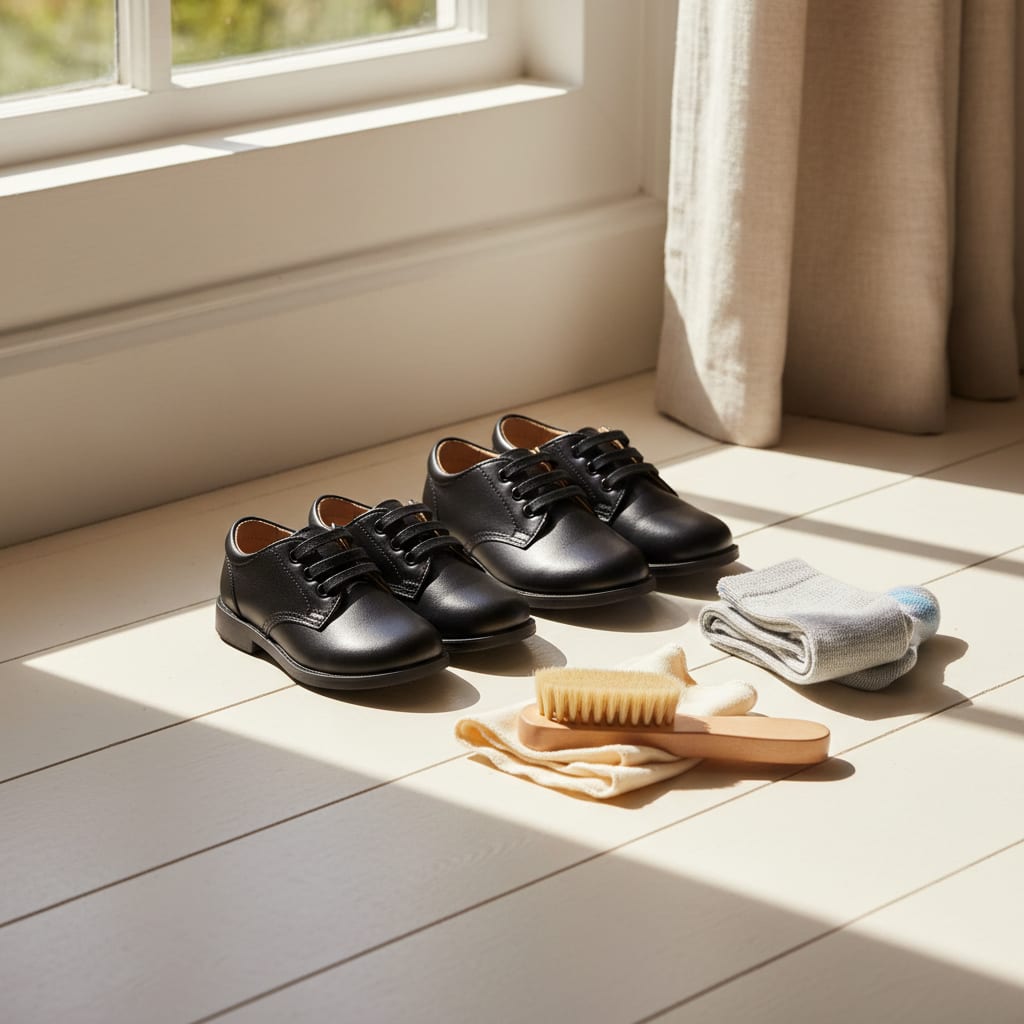
Get feet measured for length and width, buy leather with a proper fastening rather than a slip-on, and buy one pair that fits instead of two pairs that nearly do. A well-made school shoe is built to survive a school year, and the mid-range brands that do width fittings — Clarks, Start-Rite, Kickers — are where that promise is most reliably kept. Expect to pay somewhere around £35–£55 (~$45–$71) for one.
The honest caveat, before anyone spends: no shoe survives a growth spurt. Even a good pair may only last three to four months on a fast-growing or particularly destructive child, and that isn’t the shoe’s fault.
Why the cheapest pair usually costs the most
A £15 (~$20) shoe that gives up in October doesn’t save you £20. It costs you £15 plus a full-price replacement, bought in a rush, in half term, in the rain, from whatever shop still has their size.
That’s the whole argument for spending more here and less on polos. A polo shirt has one job and a supermarket does it perfectly. A shoe has to take five days a week of a playground, and it’s the one item on the list where the cheap version reliably fails inside the year.
Width is the bit most people skip
Length is what gets measured in a hurry. Width is what makes the shoe last, because a foot that’s too wide for its shoe pushes out at the sides until the upper splits, and a foot swimming in a shoe slides forward and wrecks the toe.
Most children’s brands run a standard fitting (usually labelled E or F) and a wide one (G or H). Clarks offers the fullest range of fittings, which is the actual reason it’s the default recommendation rather than the branding. Start-Rite is the other British name that measures properly and does multiple widths.
Get them measured in a shop even if you intend to buy elsewhere. Once you know the length and width, you can buy the same size online later without the gamble.
What each price bracket buys you
Rough brackets, hedged, because prices move and ranges change every summer:
Around £15–£25 (~$20–$33) — supermarket shoes. Synthetic uppers, one width, no fitting service. Genuinely fine for a child whose feet are between sizes and about to jump again, or as a spare pair. Not a shoe I’d expect to see in July.
Around £30–£40 (~$39–$52) — entry-level branded. Leather uppers, riptape fastening, a width fitting or two. This is the sweet spot for most primary-age children, and it’s the bracket that a summer clothing discount event can drop into the one below.
Around £45–£55 (~$58–$71) — the proper ones. Full leather, several widths, reinforced toes, and the versions built for children who scuff. Kickers sits up here and earns it on durability rather than looks.
Above that you’re paying for a name or a character, and neither makes the sole last longer.
What to look for in the shoe itself
Ignore the marketing and check five things:
- Leather uppers. They stretch to the foot and survive scuffing. Synthetic splits.
- A fastening that adjusts — riptape or a buckle. Slip-ons make the toes grip to keep the shoe on, which is bad for the foot and worse for the shoe.
- A sole with actual tread. Smooth soles are lethal on a wet playground.
- A reinforced toe if yours is a scuffer, which yours is.
- A thumb’s width of room at the end when standing. Any more and they’ll trip; any less and you’re buying again by Christmas.
Take the socks they’ll actually wear to the fitting. School socks are thicker than the ankle socks worn in August, and that’s half a size.
When to replace, and how to tell
Feet grow fast and unevenly. As a rough rhythm: check the fit every couple of months for reception and infant-age children, and every three months or so from about seven upwards. Between checks, watch for red marks on the top of the foot or the little toe, curled-under toes, or a child who suddenly wants to change shoes the second they get in.
Look at the shoe too. A collapsed heel counter — the stiff cup at the back — means it’s done, whatever the sole looks like. Once that goes, the shoe stops holding the foot at all.
Making one pair go further
The cheapest shoe strategy is a good pair looked after, which costs nothing but nagging:
Alternate if you can. A second pair worn on alternate days lets each dry out properly, and both then last considerably longer than one pair worn into the ground. Worth doing if you’ve inherited a spare pair, not worth buying two new pairs for.
Dry them at room temperature. On a radiator, leather cracks and glue lets go. Newspaper inside, away from the heat, overnight.
Polish the leather ones. Ten minutes on a Sunday, done with the child so it’s their job by year two.
Keep plimsolls in the bag. Half the wear on school shoes happens in PE and wet break. A pair of pumps for around £3–£5 (~$4–$6.50) takes that hit instead.
Don’t buy the summer sandals. One pair of school shoes plus trainers covers the whole year for most schools.
If shoes are the expensive end of the September list, the plain half of it doesn’t have to be — the cheap school uniform rundown covers where the supermarket bundles land and what you can stop buying altogether. And the rest of the sequencing, deadlines and admin sits in the back to school checklist, which puts shoes early on purpose. If it’s the cost of the whole month that’s the problem rather than the shoes themselves, budgeting on one income is where I put the sinking pot that pays for it.
FAQ
How long should school shoes last?
A well-made pair is designed to survive a full school year of normal wear, and often does. Three to four months is more realistic for a very active child or one going through a growth spurt, and that’s about the foot rather than the shoe. Check the fit every two to three months regardless of how the shoe looks.
Are expensive school shoes worth it?
Up to about £55 (~$71), usually yes — you’re buying leather, a real width fitting and a sole with grip, which is what makes a shoe survive a playground. Above that you’re mostly paying for the name. The saving comes from not buying a second pair in October, not from the price tag itself.
What width fitting does my child need?
Whichever one a proper measure says, which is why the in-shop fitting is worth the trip even if you buy online afterwards. Standard fittings are usually labelled E or F and wide ones G or H. A wide foot in a standard shoe splits the upper; a narrow foot in a wide shoe slides forward and destroys the toe.
Can I buy supermarket school shoes instead?
Yes, and for a child between sizes or about to grow they’re a sensible call. They’re generally synthetic, single-width and unfitted, so treat them as a stopgap or a spare pair rather than the shoe that has to get through to July. If you go this route, measure at home carefully and check the fit more often.