Baby Sleep in a Too-Hot Flat: Heating You Can't Turn Down
If your flat is too hot because of heating you don’t control, work in this order: stop the heat getting into the bedroom, move air through it, then dress the baby for the temperature you’ve actually got rather than the one you wish you had. Safer-sleep guidance puts the ideal room at 16–20°C, and in a flat on communal heating you may simply not be able to reach that in January. That is not a reason to give up on the room — it changes which lever you pull, and it means the layers on the baby matter more than usual.
This is a different problem from a heatwave and it gets treated as the same one. A heatwave ends. Heating you cannot turn down runs for months on somebody else’s timetable, and often arrives through walls and floors from flats you have never been inside.
Work out where the heat is actually coming from
The fix depends entirely on the source, and it is worth ten minutes finding out which one you have.
- A heat network. Blocks of flats are often on communal or district heating — one central boiler serving the whole building. Citizens Advice is blunt that you usually can’t switch supplier or disconnect, because the supplier owns the equipment, and plenty of these systems run on a fixed seasonal schedule residents have no say over.
- Riser pipes. In many purpose-built blocks the hot pipes serving the whole stack run through a boxed-in corner of the flat, often in a hallway or the smallest bedroom. That box radiates whether your own radiators are on or not, and it is frequently why one room is unbearable.
- A radiator with no working valve. If the thermostatic valve is seized, missing or painted over, the radiator is effectively stuck on. This one is fixable and is your landlord’s job.
- The flat below or beside you. Heat rises through concrete floors, so a top-floor flat above someone who likes it at 24°C runs warmer than the same flat downstairs, with nothing to do with your own system.
Two minutes with a hand on the walls and boxed corners tells you more than the thermostat.
Stop the heat entering the room
You cannot turn the source down, so the job becomes keeping the heat out of the one room that matters.
Shut the bedroom radiator off at the valve. Even a stuck thermostatic valve usually has a lockshield at the other end that closes with a spanner. Ask rather than guess if you’re renting — but a bedroom radiator that is off is the single biggest change most people can make.
Cover the riser box. A thick quilted throw hung over a boxed-in pipe run genuinely reduces what it radiates. Not elegant, and it works. Keep it well clear of the cot.
Let the room breathe in the daytime. A bedroom shut behind a closed door all day starts the night hot. Open it up in the morning and the night begins lower.
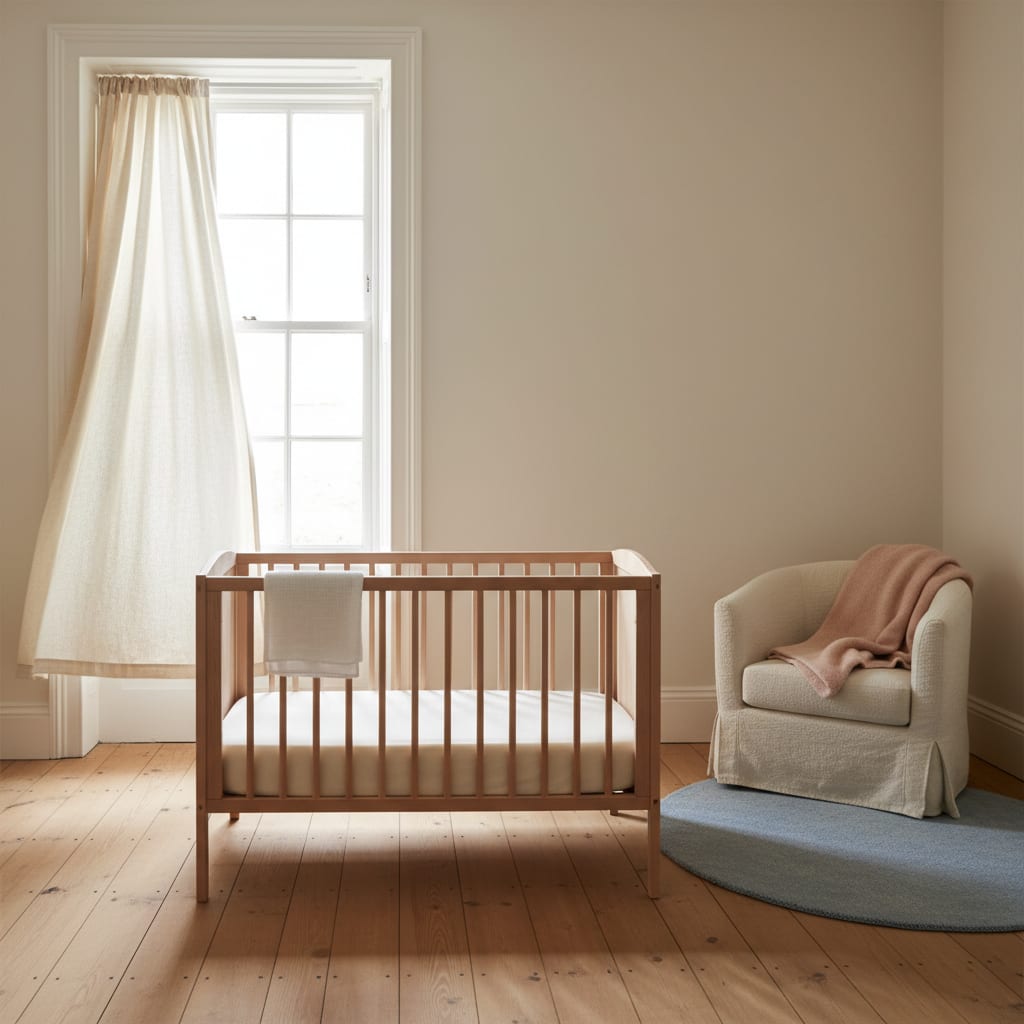
Keep the cot away from the heat. Safer-sleep guidance already says not to put a cot next to a radiator or in direct sun; here that extends to riser boxes, hot walls and the airing cupboard. In a small room, a metre is a real difference.
Move air, safely
Airflow turns “hot and still” into “warm and bearable”, and it is cheap — a basic desk or tower fan runs roughly £15–£30 (~$20–$40) and pennies a night.
The Lullaby Trust’s advice for a hot room is to open the bedroom door and a window if it’s safe, and to use a fan without pointing it directly at the baby. In a flat, point the fan out of an open window rather than in: it pulls hot air out and drags cooler air under the door. Check any window restrictors before relying on an open window all night.
Check the baby, not the thermometer
A room thermometer is useful, but not something to act on when the number is stuck at 23°C and you cannot change it. What matters is the baby.
Feel their chest or the back of their neck — hands and feet run cool on almost every baby and tell you nothing. If the skin there feels hot or sweaty, take a layer off. No hats indoors, and no duvets or quilts.
Layers are the lever you do control, and in an overheated room they are the whole game: a short-sleeved bodysuit and nothing else is a legitimate answer to a room you cannot cool. Betteroo’s guide to what to put a baby in at the temperature you’ve actually got goes through it properly, and it’s worth reading how the tog rating on a sleep sack works too, because a 2.5 tog bag bought for a cold flat is doing active harm in a hot one and most of us own exactly one.

A flat that is too hot is a housing issue, not just bad luck
This is the part nobody tells renters. Everyone knows a freezing rented flat is something the council takes seriously. Far fewer know that excess heat sits on the same list: Shelter’s legal guidance on fitness for human habitation names excess heat and cold among the prescribed hazards under the Housing Health and Safety Rating System, and a property with a serious hazard can be unfit.
So there are three routes:
- Report it as a repair. Your landlord must keep the installations that supply space heating in repair and proper working order — Section 11 of the Landlord and Tenant Act 1985, and Shelter’s repairs guidance lists heating explicitly. A seized or missing radiator valve is a repair. Report it in writing and keep the record.
- Council environmental health. If it isn’t fixed, the council’s private sector housing team can assess the flat and require works.
- The heat network route. On communal heating, complain to your supplier or landlord first, then escalate — Citizens Advice sets out the process, including the Energy Ombudsman after eight weeks if the network is registered with Heat Trust. Council and housing association tenants go through the landlord’s complaints procedure and then the Housing Ombudsman.
None of that fixes tonight. All of it matters if this is your third winter here, and the first email costs nothing.
The bit that gets forgotten
Doing this alone at 2am, in a room that will not cool, is its own kind of tired — the one behind baby sleep as a single mum. Be gentle with yourself: you are managing a building, not failing at parenting.
Two more if this is your flat — cooling a bedroom in a heatwave, because the tricks overlap, and sharing a room in a one-bedroom flat, because the problems arrive together. If the room also gets bright at 5am, blackout without drilling covers that.
FAQ
What temperature should a baby’s room be?
Around 16–20°C is the range given for safer sleep. If the heating is outside your control and the room sits above that, get it as low as you reasonably can and reduce what the baby wears to match — the layers matter more than the number.
Is it dangerous if a baby’s room is too warm?
Overheating is one of the risks safer-sleep advice is designed to reduce, so take it seriously rather than shrugging at it. Check the chest or back of the neck rather than hands and feet, take layers off if they feel hot or sweaty, keep hats off indoors and skip duvets and quilts.
Can I make my landlord turn the communal heating down?
Usually not directly — on a heat network the schedule is set for the whole building. What you can do is report an uncontrollable radiator as a repair, complain formally about the heating, and ask environmental health to assess the flat if it isn’t resolved.
Can I use a fan in a baby’s room overnight?
Yes, as long as it isn’t blowing directly onto the baby and the fan and its cable are well out of reach of the cot. Pointing it out of an open window often works better than pointing it in.
Why is one room in my flat so much hotter than the others?
Usually a boxed-in riser pipe carrying hot water for the whole block, a radiator whose valve has seized open, or a shared wall with a much warmer flat. Put your hand on the walls and boxed corners.