Baby Sleep in a One-Bedroom Flat: Sharing a Room
You do not need a separate room, and for the first six months you are not supposed to have one. The Lullaby Trust’s advice is that a baby sleeps in the same room as you, day and night, for at least the first six months — so a one-bedroom flat isn’t a compromise at that stage, it’s the arrangement. Past six months, the job is making the shared room work: a visual divide, staggered bedtimes, some steady sound, and somewhere for you to exist in the evening that isn’t a dark bedroom at half seven.
I’ve done this in a rented one-bed in London with no prospect of a second room, and I want to say clearly that nothing about it makes your baby a worse sleeper.
Room sharing is the recommendation, not the compromise
A lot of guilt evaporates on contact with The Lullaby Trust on room sharing: the same room as you for at least six months, day and night, listed among the things that lower risk rather than raise it.
What matters is the sleep surface, not the size of the room: their own clear, flat, firm space — cot, cot bed or moses basket — with nothing loose in it, and not pushed up against a radiator, a window, a curtain or a blind cord. Blind cords are the one to go and check tonight if the cot has moved.
Everything after six months is preference, logistics and housing, not safety.
Divide the room without building anything
You’re not making two rooms. You’re breaking the line of sight, so a baby who stirs at 11pm doesn’t wake fully at the sight of you.
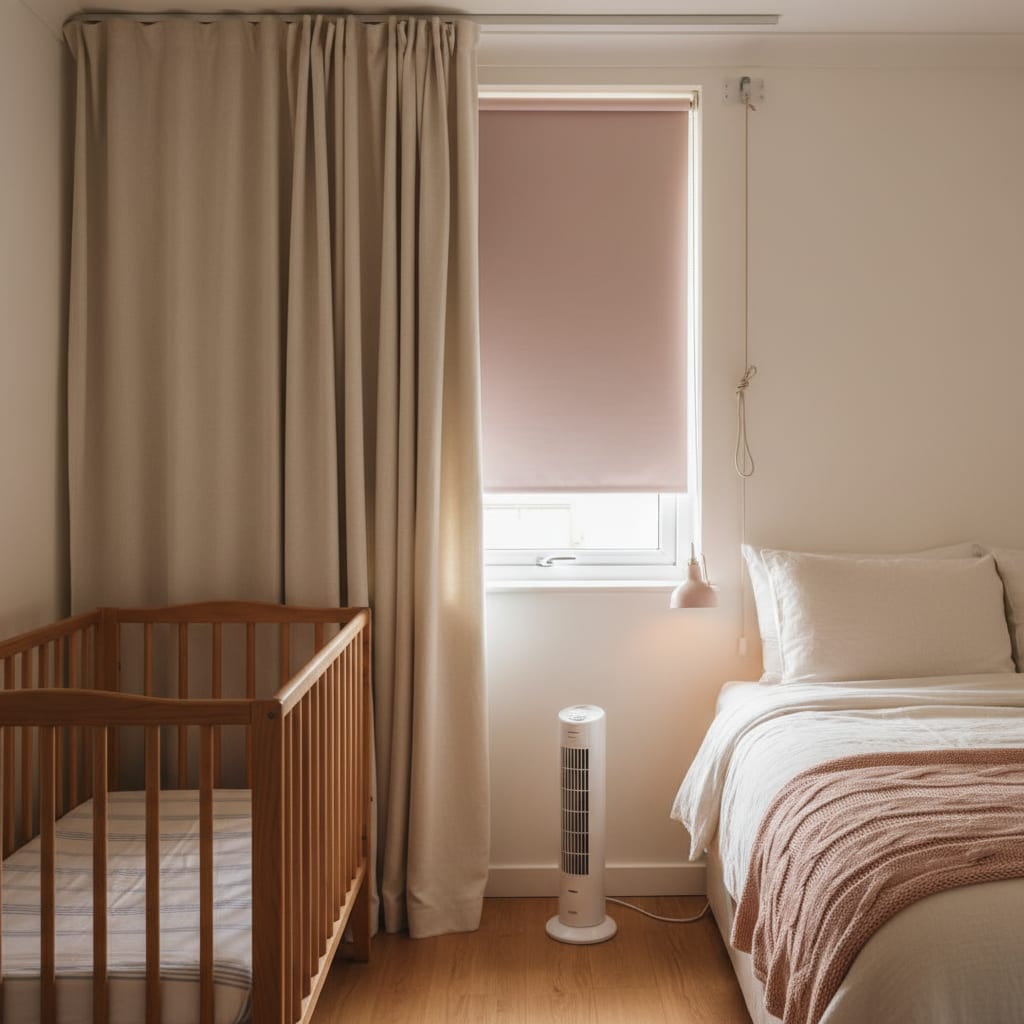
- A ceiling track or tension curtain rail with a plain heavy curtain. Around £20–£40 (~$26–$52) all in, and it comes down with the tenancy. The cheapest and most effective option by a distance.
- A wardrobe or chest of drawers turned side-on to make a corner. Free if you own one, and it doubles as a sound baffle. Fix anything tall to the wall.
- A folding screen if the layout won’t take a curtain. Pick one that can’t be pulled over and keep it clear of the cot.
- A clothes airer draped with a sheet, in a pinch, for nothing at all.
Put the cot on the quietest wall — away from the front door, the hallway and the streetlight. Then blackout the window properly, which does more for daytime naps than the divider ever will, and is what I’d spend the money on first: my dark, warm room on a budget rundown covers it.
Two bedtimes, one room
The real problem in a one-bed isn’t the baby. It’s that their bedtime is 7pm and yours isn’t, and the only door in the flat is the one you now can’t open.
What works:
Bedtime happens in the bedroom, and you leave. Settle them behind the divider, then live in the living room. Resist the urge to go to bed at eight just because you’re already in there — that’s how a one-bed swallows your entire evening.
Go in on their schedule, not yours. Slip into bed during a deep patch rather than the light sleep an hour or so after they go down. Clothes and phone charger on your side, ready, so you’re not opening drawers in the dark.
Cover your own noise, don’t eliminate it. You can’t tiptoe for four hours a night in a flat this size, and babies who only sleep in silence become babies who wake at every bus.
Kill the light. Your phone at 11pm is brighter than anything else in the room. Screen dimmed right down, face down, and a torch app rather than the big light for a nappy change.
Sound, thin walls and the neighbours
Steady sound is the biggest single lever you have in a flat, because it covers the front door, the stairwell, the upstairs floorboards and the road all at once.
A fan or a plain white noise machine at around £15–£25 (~$20–$33) does it. Put it across the room from the cot rather than beside it, keep the volume at roughly the level of a shower running, and leave it on all night — a machine that clicks off at 2am is a machine that wakes them at 2am.
On the neighbours: a baby crying at night in a block of flats is a normal sound, and most people are far more forgiving than you’re imagining at 3am. A note through the door early on buys more goodwill than months of anxious tiptoeing.
Naps when there’s no quiet room
Daytime is harder than night in a one-bed, because you need the room they’re sleeping in.
The arrangement that works for most people: put the first nap of the day in the cot behind the blackout, since it’s the one most worth protecting, and let the later ones happen in the pram, the sling or the living room, where the noise is normal and nobody has to whisper.
If naps are the bit falling apart — short, fought, or only ever happening on you — it’s usually timing rather than the flat. Betteroo’s walkthrough of nap training covers how to get a cot nap to stick, which is worth a lot more in a small flat than in a house with a spare room.
”Should they be in their own room by now?”
The honest answer is that there’s no age at which sharing stops working, and plenty of families do it for years by choice and by necessity in every city with a housing shortage. Whether a separate room actually improves sleep is a genuinely open question — Betteroo’s look at whether babies sleep better on their own is a fairer summary than the confident opinions you’ll get in a WhatsApp group.
What I’d say from doing it: don’t move yourself onto the sofa long-term to give them the bedroom. Broken adult sleep on a sofa bed costs you more than the baby gains, and you’re the one holding everything up. For a few weeks of teething or illness, fine. As a permanent arrangement, no.
And if the flat is genuinely too small for the number of people in it, that’s a housing question rather than a sleep one. Shelter’s guide to what to do if your home is overcrowded explains the bedroom standard and how it affects a council housing application, and it’s worth ten minutes even if you assume the answer is no.

Doing all of this on your own, in one room, with nobody to swap the 3am shift with is its own particular exhaustion — baby sleep as a single mum and bedtime with no one to tap in are the two I’d read next.
FAQ
Can a baby sleep in the same room as you long term?
Yes. The Lullaby Trust recommends room sharing for at least the first six months, and after that there’s no point at which sharing becomes a problem in itself. Plenty of families share for years, by choice or because of housing. What matters is that the baby has their own clear, firm, flat sleep surface with nothing loose in it.
How do you divide a bedroom for a baby in a small flat?
A ceiling track or tension rail with a heavy curtain is the cheapest and most effective option, and it comes down when you move. A wardrobe or chest of drawers turned side-on works too and doubles as a sound baffle. Whatever you use, keep it stable, keep it away from the cot, and check no cords hang anywhere near.
How do I get my own evening back when we share a room?
Settle the baby behind the divider and then leave the room — the mistake is going to bed at eight simply because you’re already in there. Have your things laid out on your side so you can slip in later without opening drawers, dim your phone right down, and use steady background sound so ordinary flat noise doesn’t wake them.
Will white noise disturb my neighbours in a flat?
It’s far more likely to help than hurt. Keep it at roughly the level of a shower running and put it across the room from the cot rather than next to it, and it mostly stays in your flat while masking noise coming in from theirs. A baby crying at night carries further than the machine does.