Blackout Blinds Without Drilling: A Guide for Renters
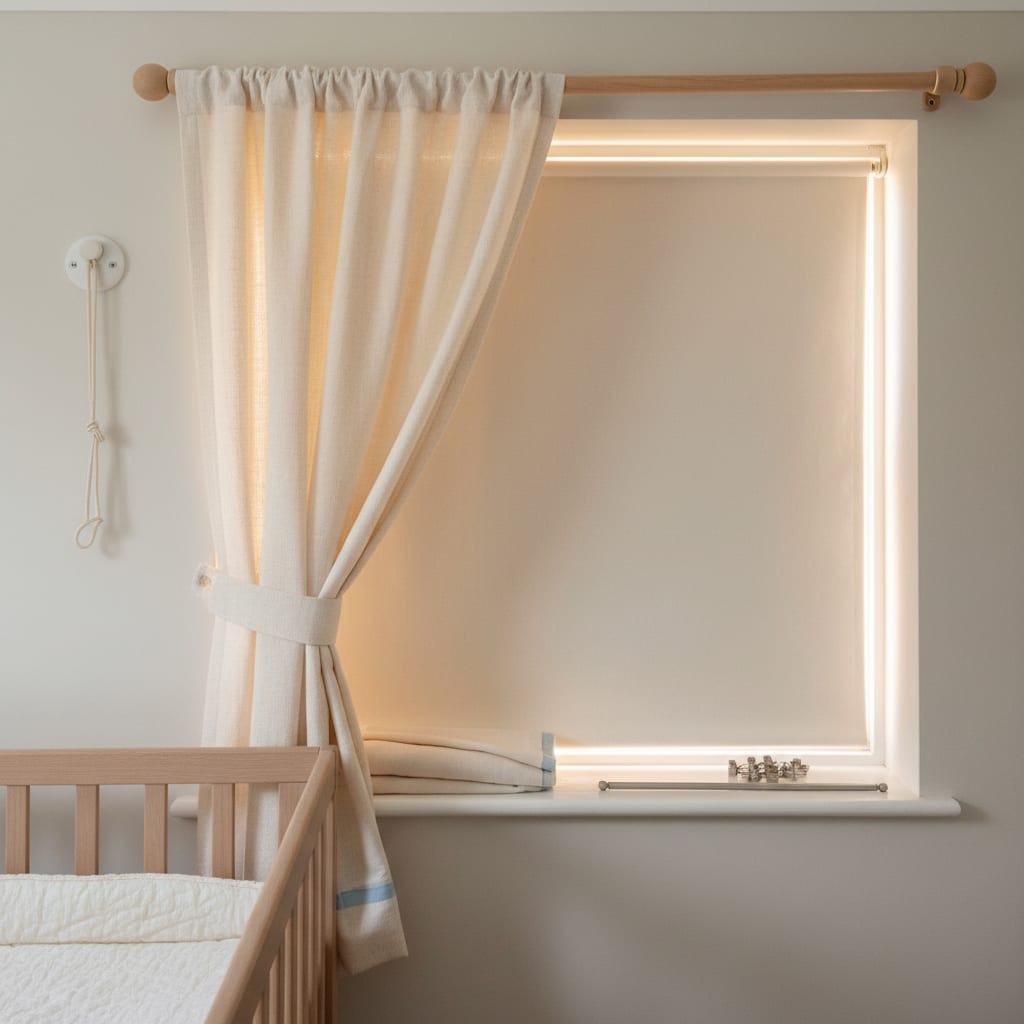
You can get a rented room genuinely dark with no drill, no screws and nothing that marks the wall — the trick is to hang from what is already there and to seal the edges rather than cover the middle. Blackout lining clipped onto the existing curtain pole, a tension rod wedged in the window recess, a suction-cup travel blind, or a board cut to friction-fit the reveal. All four leave nothing behind on moving day, and all four beat the pricey “nursery blackout curtains” that let a halo of light in around every edge.
I have rented in London the whole time I have been a mum, in flats where a picture hook felt like vandalism, and this is the version that survived three tenancies and three deposit returns.
Why the room beats the routine in a British summer
If you only fix one thing, fix the window. A British June has the sun up well past nine in the evening and back before five in the morning; even now, in mid-August, it is light past eight and light again by six. No bedtime routine argues successfully with a bedroom that looks like mid-afternoon at 7pm.
That is the honest hierarchy: a dark room makes a decent routine work, while a lovely routine in a bright room mostly makes you feel like you are failing at something you are not doing wrong. The reverse holds too — if the room is genuinely dark and nothing shifts, the problem is timing, and Betteroo’s guide to early-morning waking is what to read before buying a second blind.
What your tenancy actually says about holes in the wall
Most assured shorthold tenancies ask you not to make fixings without written permission. That is not a ban, and agents are used to the question — a short email offering to make good on the way out is worth having in writing.
Two things worth knowing. In England and Wales a deposit on an assured shorthold tenancy has to be protected in a government-backed scheme, with a proper process for disputing a deduction rather than simply losing the money: gov.uk on tenancy deposit protection sets out how. And landlords cannot charge for fair wear and tear — Shelter’s guide to tenancy deposits explains that line, with Citizens Advice on deposits as the plain-English second opinion.
Six ways to black out a window with no fixings
Best first:
- A board cut to friction-fit the recess. Foam board, thick cardboard or a cut-down blackout panel wedged into the reveal so it holds itself in. Under £10 (~$13), and the darkest option here. It looks like a squat, which is why nobody sells it.
- Blackout lining clipped to the curtains you own. A couple of metres of lining from somewhere like Dunelm plus a packet of curtain clips. Often around £10–£20 (~$13–$26) a window, hangs off the existing pole, comes off in ten seconds.
- A tension rod inside the recess. Wedges between the sides with no screws, around £5–£10 (~$6–$13), and hangs lining inside the reveal where the leak is. It holds a lining panel; it will not hold heavy interlined curtains.
- A suction-cup travel blind, the Tommee Tippee Gro Anywhere type being the one people actually own. Usually around £25–£35 (~$32–$45), and it packs for nights at your mum’s. Suction cups let go on cold, dusty or textured glass, so clean the pane and expect to re-stick it in winter.
- Adhesive-edge blackout panels stuck to the frame with hook-and-loop tape. Best seal of the removable options — but test the adhesive on a hidden corner, because on fresh paint or wallpaper this is the one that costs a deposit.
- A roller blind in brackets already up. If the landlord left a blind, you can often swap the roller for a blackout one, keep the original in the cupboard and put it back at the end.
What I would avoid is any sticky-hook route on a painted wall. They are sold as damage-free and mostly are — if you follow the removal instructions exactly, at the exact moment you are tired and moving house.
Sealing the edges is the whole job
This is what separates a dark room from a dim one, and why the £60 (~$78) curtains disappoint people. Fabric hung on a pole in front of a window has a gap at the top, a gap down each side and a glowing line along the floor. At 5am in June, those gaps are the room.
So: fit inside the recess wherever you can. If you must hang outside it, overhang generously on all four sides and let the fabric reach the floor or sill. Run foam draught excluder down the edges of a board to kill the last hairline. Then do the daytime test — door shut, at lunchtime, hold your hand up. Clear hand, bedroom. Vague shape, sleep room.
For which shop-bought options genuinely stop light rather than soften it, Betteroo’s rundown of what to look for in a blackout blind is a sanity check before you spend.
Sold as blackout, isn’t
Balanced, because I have bought most of these:
“Blackout” curtains that are simply thick. Plenty carry the word and mean dark-coloured. If light glows through the fabric in the shop, it will glow through at dawn.
Window film. Frosted and mirrored films are privacy products. They stop people seeing in, not daylight.
Nursery-branded anything. The same blind, in the baby department, at a markup — a pattern I hit before working out how to build a dark, warm room for less.
Travel blinds sized for a porthole. Check the dimensions against your actual glass before you order, not after.
Two safety rules that override everything
Cords and chains do not go near a cot. Any blind in a room where a child sleeps needs its cord cleated high and tight, or a cordless blind instead — RoSPA on blind cord safety covers what safe looks like. And nothing above a cot should be able to fall into it, which is why friction-fit boards want wedging properly rather than balancing. The Lullaby Trust’s safer sleep advice is the reference for cot placement: clear, flat, firm, away from windows, blinds and radiators.
Getting your deposit back at the end
Photograph the window and wall the day you move in, before you touch anything, and again the day it comes down. Keep the landlord’s email. Keep the original blind, curtains and brackets in a bag at the back of the wardrobe, not at the tip. Take everything down a week before checkout, not on the morning, so there is time to fill a pinhole or wipe a suction mark. It has never cost me a deduction.
When it isn’t the window
A dark room fixes light-driven wake-ups: the 5am start, the thirty-minute nap, the bedtime that will not take in July. It does not fix a drifted schedule, a regression, or a room that is simply too hot — often the real culprit in a top-floor flat in August, which I have written up as cooling a bedroom that will not cool. If one room has to do everything, sharing a room in a one-bed covers dividing it up.

FAQ
How do you fit a blackout blind without drilling?
Use something that holds itself up. A tension rod wedges inside the recess, a board cut slightly oversize friction-fits the reveal, a suction-cup blind sticks to the glass, and blackout lining clips onto the curtain pole already there. All four come down without leaving a mark.
Will a landlord let me put up a blackout blind?
Usually, if you ask. Most tenancy agreements require written permission for fixings rather than banning them, and an email offering to make good at the end is normally enough. If you would rather not ask, the no-fixings options above avoid the question.
Do blackout blinds really help children sleep?
They help most with early-morning waking and daytime naps, because light is the strongest signal the body clock has, and a British sunrise through thin curtains genuinely does start the day. They will not fix a drifted schedule or an overheated room.
Are cheap blackout options as good as expensive ones?
Often better. A board cut to the recess blocks more light than most branded blackout curtains, because darkness comes from the seal at the edges rather than the thickness of the fabric. Spend on the seal, not the label.