Cheap School Uniform: Supermarket Sales & Smart Buys
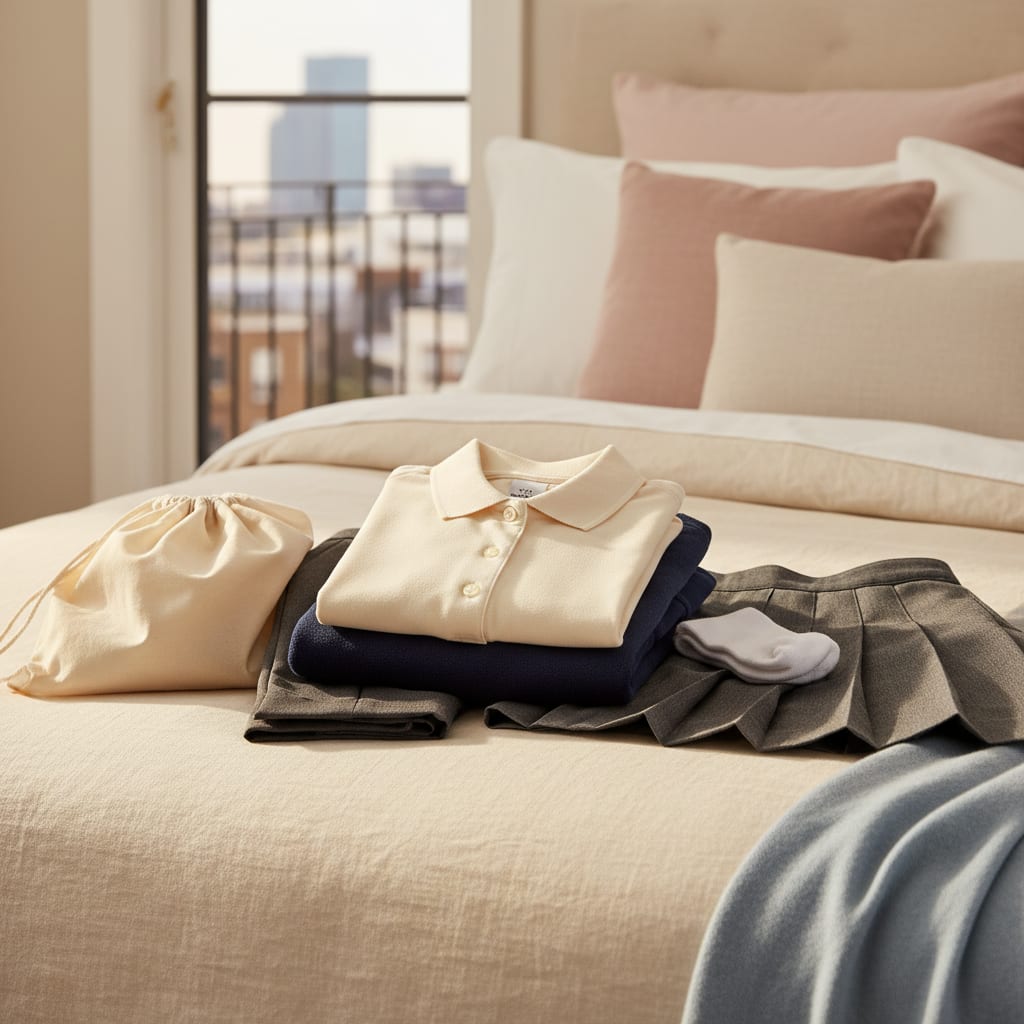
Buy the plain bits from a supermarket, get anything with a logo on it second-hand, and read the uniform list before you spend anything. Aldi and Lidl both run a five-piece bundle for around £5 (~$6.50) from late June, and Tesco, Asda and Sainsbury’s each run clothing discount events several times a year. And from this September, English state schools can only make three branded items compulsory — four at secondary if one of them is a tie — so a chunk of last year’s list may no longer be required at all.
That last point is the one worth ten minutes of your evening, because it’s the difference between a supplier order and a supermarket order.
The rule that changes what you have to buy
The Children’s Wellbeing and Schools Act 2026 caps compulsory branded uniform at three items for primary schools, and four for secondary schools where one is a tie. It’s expected to be in force for the school year starting in September 2026.
Two details matter more than the headline:
- “Branded” is broader than a logo. An item counts as branded if, because of its colour, design, fabric or some other distinctive feature, it can only be bought from a particular supplier. The bottle-green trousers that only one shop stocks are a branded item even with nothing embroidered on them.
- The cap covers everything, including bags and PE kit. School uniform is defined widely — a bag, and clothing needed for school or for any lesson, club, activity or event the school runs. A branded book bag, a branded PE top and a branded jumper is your three, at primary, before you’ve bought a coat.
Schools can still offer extra branded items. They just can’t insist. So the reasonable question to the office — and it is reasonable, in writing, politely — is: which items on this list are compulsory, and which are optional?
The gov.uk guidance on school uniform costs is the thing to have open while you ask.
Supermarket bundles, and when they actually land
The cheap uniform window opens far earlier than most of us shop.
Aldi brings back its five-piece bundle — two polos, a sweatshirt or cardigan, and a choice of trousers, shorts or a pleated skirt — at around £5 (~$6.50). It landed on 28 June this year. It sells out, and when it’s gone it generally doesn’t come back.
Lidl runs a near-identical event with its own roughly £5 bundle covering ages 3–11, also on a twelve-month guarantee. Same rule: it’s a stock event, not a permanent range.
Tesco’s F&F range goes into a 25% off all clothing event several times a year. Asda’s George does a uniform-specific discount event in late June. Sainsbury’s Tu runs 25% off clothing roughly four times a year with uniform and school shoes included.
The practical version of all that: buy in late June and early July for the bundles, and treat any clothing discount event between now and October as the moment to top up. If you’ve missed the window this year, put a reminder in your phone for mid-June next year — that single note is worth more than any voucher code.
How much uniform one child really needs
Buying too much is where the budget actually goes, not buying the wrong brand. For a primary-age child who is washed for once a week:
- Five polos or shirts. Enough for a week, so one bad Tuesday doesn’t force a wash.
- Two or three bottoms. Trousers, skirts or pinafores. Buy these to fit now, not big — a trouser that’s too long trips them up in the playground.
- Two jumpers or cardigans. These are usually the branded ones. Two is genuinely enough.
- One PE kit, plus plimsolls. Two PE kits if PE is twice a week and you can’t face a mid-week wash.
- More socks and pants than seems sane. They vanish.
- One coat. Not a school coat — a coat.
Buy tops slightly big and bottoms exactly right. Tops ride up and look fine; trousers that are too big fall down and get replaced anyway.
Second-hand first for anything with a logo
Branded jumpers get worn twice a week and outgrown, not worn out — which is exactly why the second-hand market for them is so good.
Try, in this order: the school’s own uniform rail or swap shop, the PTA sale, the local parents’ Facebook group, then the charity shops nearest the school. None of these are advertised well and most schools have one. Asking the office where the second-hand uniform lives is admin, not a confession, and the person you ask has been asked forty times this month.
Wash everything at 30, unpick the previous child’s name tape, and write over it with a Sharpie on the care label. Nobody has ever noticed.
Help with the cost, before you spend a penny
Do this bit first, because it can change what you buy.
- School clothing grants. Scotland, Wales and Northern Ireland run national schemes. In England it depends entirely on your council and many no longer offer anything. Start at gov.uk’s page on help with school clothing costs, then search your own council’s site.
- Register for free school meals if you’re eligible, at gov.uk. Even in infant years where meals come automatically, registering can unlock help with trips, kit and uniform at many schools.
- Ask the school about its hardship fund. Most have one. Almost none mention it.
If the uniform bill is landing on top of everything else this month, the way I actually stage costs like this across a single income is in my budgeting on one income system — the short version is that uniform is a known August cost, so it belongs in a sinking pot from January, not on a card in September.
Where cheap genuinely costs more
Two exceptions to all of the above.
Trousers, at the knee. The cheapest bottoms go through at the knee by half term and you buy them twice. Mid-range trousers with a reinforced knee are the one supermarket upgrade worth taking.
Shoes, always. A pair that gives up in October has to be replaced in October, at full price, in a hurry — which is why school shoes get their own post on what’s actually worth the money rather than a line here.
Everything else — polos, PE tops, socks, bags — buy the cheapest thing that fits. And if the rest of the September admin is still ahead of you, my back to school checklist puts it in deadline order so the expensive bits don’t collide.
FAQ
When is the cheapest time to buy school uniform in the UK?
Late June and early July, when Aldi and Lidl run their bundle events and Asda discounts uniform. After that, the next-best moments are the general clothing discount events at Tesco and Sainsbury’s, which run several times a year. September is the worst time to buy — the bundles are gone and you’re paying full price under time pressure.
Do I have to buy uniform from the school’s supplier?
For most items, no. From September 2026 English state schools can require no more than three branded items at primary, or four at secondary if one is a tie, and “branded” includes anything only available from a nominated supplier. Anything beyond that cap can be offered but not made compulsory, so plain equivalents from a supermarket are fine.
Where can I get free or cheap school uniform?
School uniform swap shops and second-hand rails, PTA sales, local parents’ groups and charity shops near the school. On top of that, Scotland, Wales and Northern Ireland run school clothing grants, some English councils offer help, and many schools hold a hardship fund they don’t publicise. Ask the office directly.
How many school jumpers and polo shirts should I buy?
Roughly five polos or shirts, two or three bottoms and two jumpers for a primary-age child on a weekly wash. That covers a full week with a spare, without buying a wardrobe they’ll outgrow by February. Buy tops a size up and bottoms to fit properly.