Easy Halloween Crafts for Kids (Cheap, Not Scary)
The cheapest Halloween crafts use paper, jars, leaves and salt dough — four things most houses already have — and the not-scary versions are simply the same shapes made without faces. A pumpkin is a pumpkin whether or not it has teeth. A ghost is a ghost as a plain white shape. If you have a child who loves the idea of Halloween and then cannot sleep after the shop display, that distinction is the entire craft plan.
Everything below costs nothing beyond a glue stick and works on a wet October afternoon. I have ordered them by how much mess they make, cheapest and calmest first.
Why “not scary” is a design decision, not a softening
Small children read faces before they read anything else, which is why a carved grin does more work than any amount of black and orange. Take the face off and the same object becomes autumn decoration. Leave it on and it follows them upstairs at bedtime.
So the rule in this house is: the shape can be spooky, the face cannot. Bats are fine. Bats with eyes are the problem. This is not a rule for every child — my eldest was carving fangs at four — but it turns Halloween crafts into something you can do with a mixed-age group without one of them having a bad night.
Paper crafts (free, zero mess)
Paper chain bats. Fold a strip concertina-style, draw half a bat shape against the fold, cut, open out. Black paper if you have it, white paper coloured in if you don’t. String them across a doorway.
Spider webs from a paper circle. Fold a circle into eighths, snip triangles out of both folded edges, open it. Every one comes out different, which is the bit children actually enjoy.
Ghost bunting. Cut plain white paper into rounded bell shapes, punch two holes at the top, thread string through. No faces — a row of blank white shapes moving in the draught is atmospheric in a way that a drawn-on grin never is.
Tissue-paper stained glass. Torn scraps of orange and black tissue glued to a sheet of baking parchment, taped to the window. Best light in the house on a grey day and it uses up the bottom of the craft drawer.
If the glue needs twenty minutes to dry, that gap is exactly the right length for a round of simple paper games at the same table, with the same paper, and no extra setting up.
Jar and tin crafts (free, slightly more mess)
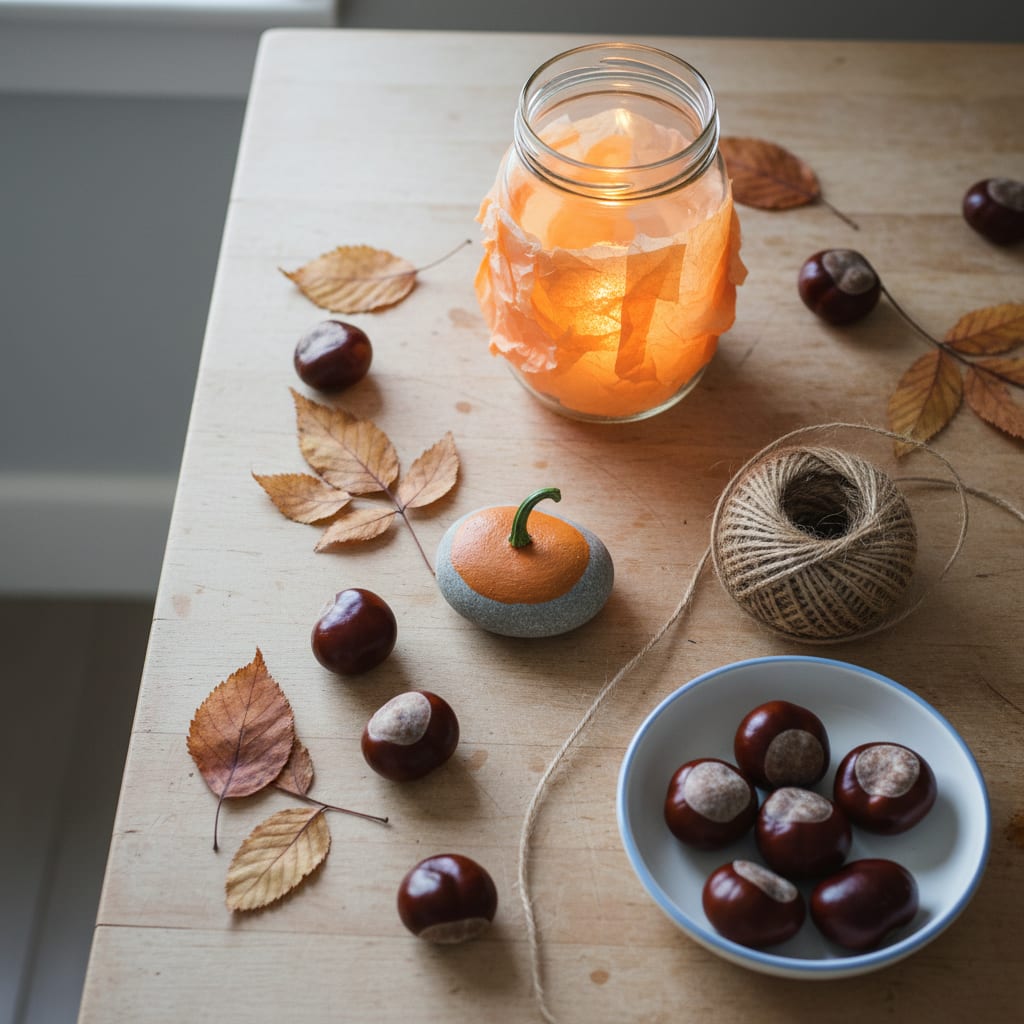
Lantern jars. A clean jam jar, tissue paper stuck all over the outside with watered-down PVA, a battery tea light inside. Orange tissue makes a pumpkin, white makes a ghost light, green makes something swampy. They line a front path beautifully and survive rain.
Use battery tea lights rather than real candles for anything a child has made and will want to carry. And keep the whole battery question in mind: the small round cells in cheap tea lights are exactly the thing to count out and count back in, and to store out of reach of anyone still putting things in their mouth.
Tin can lanterns are the older-child version — punch a pattern of holes in a clean tin with a nail and hammer, tea light inside — but that one is properly supervised, gloves-on work and not a five-year-old job.
Nature crafts (free, and gets you out of the house)
October is the one month where the craft materials are lying on the ground. Collect on a walk, craft in the afternoon.
Painted conker spiders — a conker, four pipe cleaners or four twigs pushed through plasticine, done.
Leaf bats. Two dark leaves as wings either side of a smaller one as a body, glued to paper. Ash and beech leaves work best because they hold their shape as they dry.
Pumpkin stone. Any smooth stone, painted orange, a green stalk at the top. It lives on the doorstep all month and costs a stone.
There is more of this — conkers, leaf printing, what keeps and what crumbles — in the autumn crafts post, which is really the same afternoon three weeks earlier.
Dough and baking crafts (messiest, most popular)
Salt dough pumpkins and bats. Roll, cut with a cutter or a knife, bake low and slow, paint when cool. They keep for years, which is the argument for doing them rather than paper: the box that comes down every October is half the point. My salt dough recipe has the oven temperature and the drying times, which are the two things everyone gets wrong.
Orange and black playdough. If you are making it anyway, make it seasonal — the playdough recipe takes a few drops of food colouring and about eight minutes. Cutters plus googly eyes plus pipe cleaners keeps a four-year-old going for an hour, and it all goes back in the tub afterwards.
Ghost biscuits. Any plain biscuit dough cut with a round cutter and iced white. The not-scary version is no face at all; the slightly-scary version is a face drawn on with an icing pen, decided by the child eating it.
What to buy, if anything
Honestly: a black marker pen, a glue stick and a packet of battery tea lights. Around £5 (~$7) covers all three if you do not already have them, and the tea lights come back out every year. Everything else on this list is paper you have, jars you were recycling, leaves that are free and flour that was in the cupboard.
The one thing worth resisting is the craft kit. A boxed “make your own Halloween lantern” kit is a jar, some tissue and a tea light with a cardboard sleeve round it, at several times the price of a jar, some tissue and a tea light.
Where the crafts end up
Make them three weeks out and they are decorations by the time you need decorations — which means the making and the decorating are one budget rather than two. They go straight onto the table for Halloween party food, and they cover the wet afternoons in half term when nobody wants to leave the flat.
FAQ
What Halloween crafts can I do with things I already have?
Paper chain bats, folded-paper spider webs and ghost bunting need only paper and scissors. Jam jars plus tissue paper make lanterns, conkers and leaves make spiders and bats, and salt dough makes decorations that last for years. A glue stick and a black pen cover almost everything else.
What are good not-scary Halloween crafts for toddlers?
Make the shapes and leave the faces off. Plain white ghost bunting, orange pumpkin stones with green stalks, bat silhouettes without eyes, and tissue-paper lantern jars all read as Halloween without the element that frightens small children, which is almost always the face.
Are Halloween crafts safe for under-threes?
With two adjustments: battery tea lights rather than real candles, and the small round batteries counted out and counted back in, kept well out of reach. Googly eyes, pipe cleaners and small beads are choking-sized, so those are supervised-table items rather than free-play items at that age.
When should we make Halloween crafts?
Three to four weeks before, which lands in late September or the first half of October. Made early they become the decorations, so you are not buying decorations separately, and the wet afternoons in October half term already have something planned for them.
How do I do Halloween crafts cheaply without a craft cupboard?
Buy nothing until you have looked in the recycling. Jam jars, cereal boxes, the inside of kitchen roll tubes and last week’s newspaper cover most of this list. The only genuinely worthwhile purchases are a glue stick, a black pen and battery tea lights, and the tea lights come out again every year.