Noisy Neighbours and Baby Sleep: Fixing a Party Wall
You cannot soundproof a rented flat, and chasing that is how people waste a hundred pounds on foam tiles. The move that works is the opposite one: stop trying to block the neighbour’s living room and raise the baseline inside the nursery, so their telly stops standing out against silence. Add moving the cot, blocking air gaps and putting mass on the shared wall and you have most of the available win — the biggest single change costs nothing. Genuine late-night noise is a separate route, and the council does act on that.
My youngest’s cot backed onto a neighbour’s sofa for two years. Every 10pm laugh track came through like it was in the room.
Why their telly wakes your baby and your hoover doesn’t
Sound reaches your baby two ways, and only one is fixable on a tenant’s budget. Airborne noise — voices, the telly — travels through gaps far more than through the wall itself. Structure-borne noise — the bass line, a door slam, footsteps on bare boards — travels through the building’s frame and carries on going. That’s why you hear the thud of their action film and not the dialogue.
The other half is contrast. A baby doesn’t wake at a decibel level, they wake at a change. Twenty minutes of murmuring then a sudden laugh is worse than a constant hum twice as loud. That fact decides every fix below.
Find the loud corner before you move anything
Stand in the nursery in the evening — while they’re actually watching something — and walk the room with your ear near the wall. There’s nearly always one clear hotspot, and it’s their TV or their sofa on the other side of the plaster.
Two things follow. The cot goes as far from that spot as the room allows, ideally diagonally opposite. And whatever mass you own goes on that spot, not spread evenly along the wall.
While you’re rearranging, re-check the basics against The Lullaby Trust’s safer sleep advice — clear, flat, firm sleep space, nothing loose in the cot, not against a radiator, no cord within reach.
Raising the floor instead of blocking the noise
Steady, boring sound across the room from the cot, at roughly the level of a running shower, all night rather than on a timer. It doesn’t cancel the neighbour; it removes the silence their noise stood out against. A cheap desk fan pointed at a wall does it well, and costs around £10–£20 (~$13–$26).
Two things matter more than the machine: it stays on all night — a timer cutting out at 11pm hands the room back to the party wall at the worst hour — and it sits away from the cot, not beside it. Betteroo’s rundown of what to look for in a sound machine covers the distance and volume side properly, including why continuous beats cycling tracks.
What I’d skip: anything with a heartbeat or lullaby loop. Loops have a start and a stop, which is exactly the contrast you’re trying to get rid of.
What costs nothing
- Move the cot off the hotspot. Free, and it beats anything you can buy.
- Turn the wardrobe against the shared wall. A full wardrobe or loaded chest of drawers is real mass. An empty one is a drum.
- Close the internal doors. Nursery and hallway doors shut cuts the path from the stairwell, which in a conversion is often louder than the wall.
- Shift bedtime by twenty minutes, once. If they reliably come in at 7.30, having your baby deeply asleep by then beats fighting it nightly.
- Pull the cot a hand’s width off the wall. Contact with plasterboard sends vibration into the mattress base.
What’s worth spending on in a rented flat
Rough prices, and all of it moves with you:
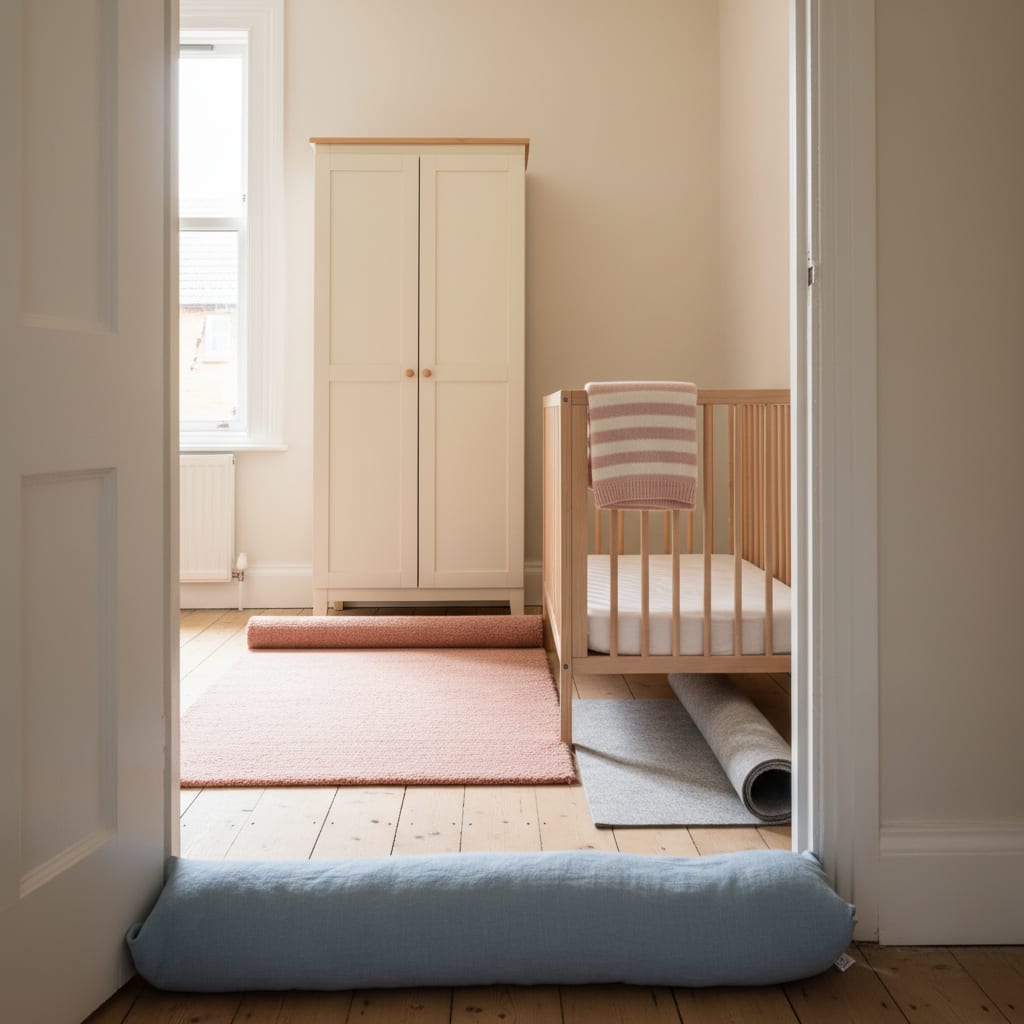
- A draught excluder or brush strip for the nursery door, around £5–£10 (~$7–$13). Gaps carry more than walls, and it pays for itself over a winter.
- Felt or rubber-crumb underlay under whatever rug you already own, roughly £15–£25 (~$20–$33). Underlay does most of the work; the rug is just the bit you can see.
- Heavy interlined curtains, floor length, about £15–£30 (~$20–$39) second-hand. On a tension rod across the shared wall rather than a window, they’re a real baffle and leave no marks.
- A second-hand full bookcase from Facebook Marketplace or Gumtree, often free to £25 (~$33). Packed with books and stood against the hotspot, it’s the cheapest mass there is.
What I wouldn’t buy: egg-box foam tiles sold as soundproofing. They change how a room echoes, do nothing to what passes through a wall, and take the paint with them when they come off.
Fixings, damage and what a landlord will actually allow
The rule of thumb that keeps your deposit: anything freestanding is fine, anything screwed or glued needs asking.
Furniture, rugs, tension rods and draught excluders are all fine. Acoustic panels, mass-loaded vinyl and resilient bars need drilling into the party wall — a written-permission job, rarely worth it on a short tenancy. Adhesive panels are the trap: they read as damage-free and take plaster off.
If your landlord also owns next door, put it in writing to them — an agent with two tenants in one block has a reason to act that a private neighbour doesn’t. Same non-drilling logic as blackout blinds without drilling.
When it stops being ordinary noise and becomes the council’s job
This is the part that flips compared to worrying about your own baby. A crying baby isn’t anti-social behaviour — but loud music, parties and thumping bass at 1am are, and councils have a duty to investigate.
The gov.uk page on reporting a noise nuisance sets out what environmental health acts on and how to report it, including out-of-hours teams in many boroughs. Citizens Advice on complaining about a neighbour gives the order: talk to them first if you safely can, keep a diary of dates, times and what you could hear, then report.
Start the diary before you’re sure you’ll need it: nobody reconstructs three weeks of 1am from memory, and the log is what turns “they’re noisy” into something actionable. Ordinary evening telly won’t clear that bar — for that, the fixes above are what you’ve got.
Naps are the harder half of this
Nights are easier than you’d think — most neighbours go quiet eventually. Daytime is the real problem: their living room is in use from breakfast, and a 40-minute nap ended by a slammed door is what breaks a week.
Same fixes, plus one: run the masking sound for naps too. And before you blame the wall for everything, rule out the ordinary developmental reason — Betteroo’s guide to naps that keep ending early covers the sleep-cycle side, which trips up plenty of babies in perfectly quiet houses.

If it’s your own baby’s noise worrying you rather than theirs, that’s the other direction of the same wall — thin walls and neighbours. And if there’s no separate room at all, start with sharing one bedroom with a baby.
FAQ
How do I stop neighbour noise waking my baby?
Move the cot as far from the noise as the room allows, put mass — a full wardrobe or packed bookcase — against the loud spot on the shared wall, block the gap under the door, and run a steady masking sound all night. Masking matters most: babies wake at sudden changes, not at a constant level, so removing the silence beats blocking the wall.
Can I soundproof a rented flat without drilling?
Not properly. Real soundproofing means fixing mass or resilient bars to the structure, which needs written permission. Without a single hole you can still use furniture, underlay, heavy curtains on a tension rod and draught excluders — all freestanding, and all of it moves with you.
Do acoustic foam panels block noise from next door?
No. Foam changes how sound bounces around inside a room, which is why studios use it, but it barely touches sound passing through a wall. Adhesive versions also pull plaster and paint off, risking your deposit for no benefit.
Can I complain to the council about noisy neighbours?
Yes, when it’s the sort environmental health treats as a statutory nuisance — loud music, parties, persistent late-night noise. Talk to your neighbour first if it’s safe to, keep a written log of dates and times, then report it via gov.uk or your council’s site. Ordinary daytime household noise won’t meet the threshold.