What's a Realistic Food Budget for a UK Family?
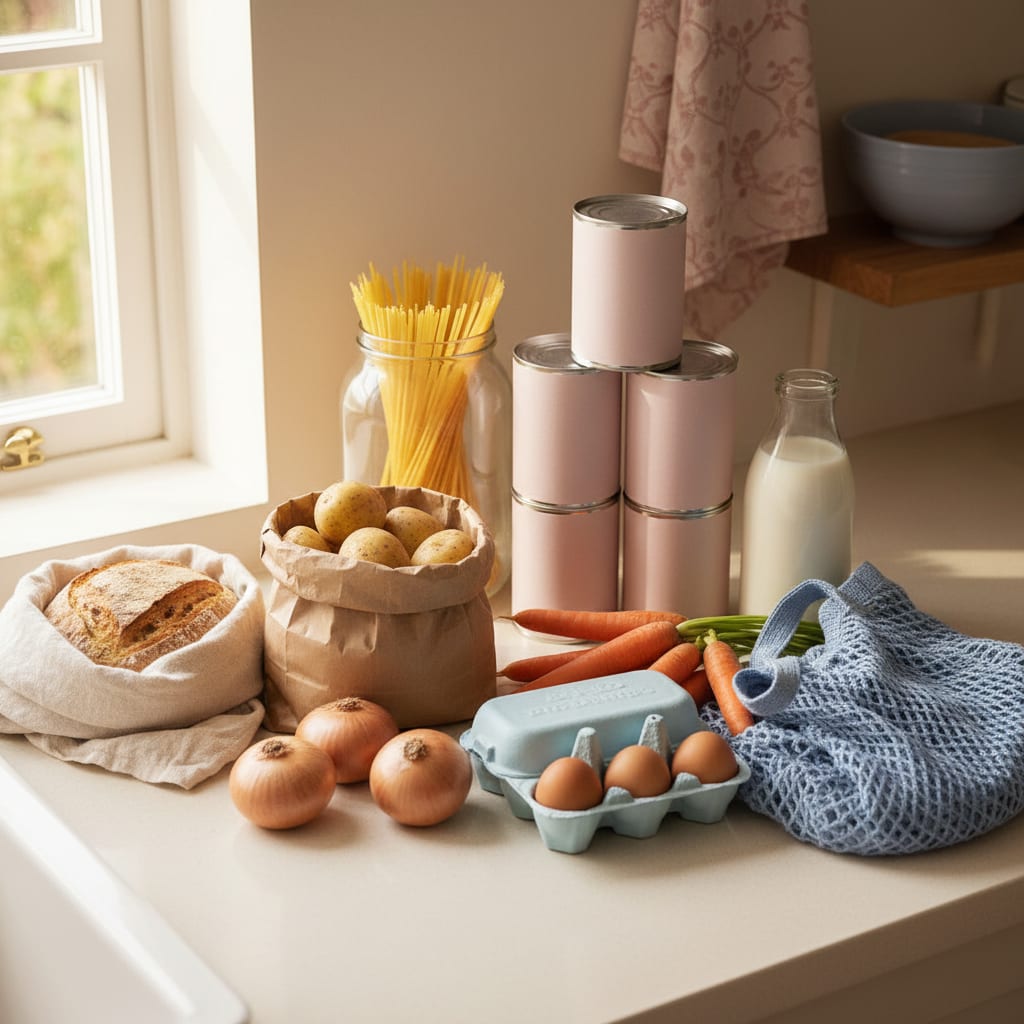
There is no single right number, but a realistic UK food budget usually works out somewhere around £4 to £7 per person per day — which for a family of four is roughly £110 to £200 a week including everything you eat. The spread is that wide because “food budget” means completely different things to different households: some people count only the big shop, others include lunches at work, the school dinner money, the Friday takeaway and the coffee on the way to the childminder. Compare your number to someone else’s without checking what’s inside it and you’ll come away feeling terrible for no reason.
So this post is less “here’s the correct amount” and more “here’s how to find yours” — because the honest answer to am I spending too much on food is only ever available from your own bank statement.
Why “average food shop for a family of 4” is a useless benchmark
A family of four with two toddlers and a family of four with two teenagers are not remotely the same shopping problem. Neither are a family who cook every meal from scratch and a family where two adults buy lunch at work five days a week. And none of them are the same as a household where somebody has coeliac disease, or a dairy allergy, or where the nearest shop is a Tesco Express because there’s no car.
Where you live matters too, and it matters more than people admit. A London convenience shop and an out-of-town Aldi are pricing the same basket differently, and if you can’t get to the second one, that’s not a budgeting failure — it’s geography.
So when you see a national average, treat it as trivia rather than a target. The number worth knowing is your own, tracked honestly, compared to itself last month.
What we actually spend
Full disclosure, because I think vague money talk is useless. There are three of us — me and two children — and our food comes to roughly £75 a week (~$99) across everything: the main shop, the top-up bread-and-milk runs, the odd bits, school dinner money on the days they have it. That’s about £3.50 a head a day.
It has not always been that number. It was noticeably higher for a couple of years when I was shopping in small amounts several times a week, buying whatever felt manageable at the end of a long day, and throwing out a shameful amount of limp veg. Nothing about my income changed. What changed was that I started planning.
The other honest bit: that £75 includes treats. It includes crisps, ice lollies in summer, the biscuits nobody needs. A food budget you can only hit by removing every pleasure from your week is a diet, not a budget, and it will collapse by February.
How to find your real number in four weeks
- Add up everything food-related for four full weeks. Not just the supermarket — the corner shop, the school dinner payments, the meal deal, the takeaway, the coffee. Your banking app’s spending categories will get you 90% of the way in about ten minutes.
- Divide by four, then by the number of people, then by seven. That’s your per-person, per-day figure. This is the only food number that’s comparable between households.
- Split it into two buckets: planned food (the shop) and unplanned food (everything else). For most people the unplanned bucket is far bigger than they expect, and it’s where all the easy savings are.
- Set next month’s target 10% lower — not 40%. Ambitious cuts fail. A tenth is invisible and it holds.
The four levers that actually move the number
A meal plan. This is far and away the biggest one, and it’s boring, and it works. Knowing what Tuesday’s dinner is stops the 5pm “there’s nothing in” panic that ends in a delivery. Ours runs off a simple weekly meal plan built around what’s already in the cupboard.
Fewer, bigger shops. Every extra trip to a shop is an opportunity to buy things you didn’t intend to buy. One planned shop plus one small top-up beats four “quick” visits, every time.
Cheap-base dinners on rotation. Not every meal has to be a bargain — you need maybe six or seven genuinely cheap dinners you can rotate through the week, so the more expensive ones have something to average against. Our list of cheap family meals is exactly that: the dependable, unglamorous backbone.
Waste. The single most expensive food in Britain is the food that goes in the bin. Freeze bread the day you buy it, cook the veg that’s turning rather than mourning it, and let leftovers become a proper meal — a batch cook on a Sunday is really a waste-prevention system wearing a chef’s hat.
What to include and what not to bother counting
Include: groceries, top-ups, school meals, work lunches, takeaways, coffees, the wine, the kids’ snacks at soft play. Anything that goes in a mouth.
You can leave out cleaning products, nappies and toiletries — supermarket shops mix them in with the food, but they behave completely differently and lumping them together hides what’s really happening. If it’s simpler to count the whole supermarket bill, do that, just be consistent month to month.
The rule that matters: count it the same way every time. A budget you change the definition of is a budget you can’t compare.
When the number won’t come down
Sometimes you do all of this and the figure is still uncomfortable, and the honest answer is that food prices have moved a lot and household budgets haven’t kept pace. If your food spend is squeezing everything else, that’s a bigger conversation than meal planning: it’s worth checking whether you’re claiming everything you’re entitled to, whether free school meals apply to your household, and what a local food club or community pantry can add. There’s no shame anywhere in that paragraph — I’d rather you eat.
School holidays are their own budget event, incidentally, since the free lunches disappear and the days out arrive. Our kids eat free roundup is genuinely part of my holiday food budget, not just a day-out trick.
FAQ
How much should a family of 4 spend on food a week in the UK?
Realistically anywhere from around £80 at the very careful end to £200 or more depending on where you shop, how old the children are and how much you eat out. A useful check is per person per day: under about £4 a head is tight and takes planning, around £5 to £6 is comfortable-but-careful, and above that you’ve usually got convenience food or eating out baked into the total.
Does meal planning really save money?
More than any other single change I’ve made. It works by removing decisions at the worst time of day — the expensive purchases are almost never the shop, they’re the 5pm “I can’t do this” moments. Plan the week and those moments mostly stop happening.
Is Aldi or Lidl actually cheaper for a family shop?
Usually yes on a like-for-like basket, particularly on fresh produce, dairy and store-cupboard basics. The catch is that they don’t stock everything, so if a discounter trip turns into a second trip elsewhere you can lose the saving in fuel and impulse buys. If there’s one near you, use it for the bulk of the shop and accept a short list of things you get elsewhere.
How do I budget for food when my income changes week to week?
Work in weekly amounts rather than monthly, keep a small freezer buffer of batch-cooked meals for the lean weeks, and set your baseline at what a bad week can cover rather than an average one. Anything above baseline in a good week goes to the buffer, not the shop.