Baby Sleep in a Caravan or Narrowboat: Moving Aboard
Moving a small child from a house into a caravan or a narrowboat is not really a space problem — it is three specific problems, and all three are fixable. The temperature swings much faster than a house does, the bed is furniture for part of the day, and there is no door between your evening and their sleep. Start with the temperature, because it is the one with a safety number on it: the Lullaby Trust puts the ideal at 16–20°C, and a van or a boat can leave that range in under an hour.
Everything else — the routine, the darkness, the wind-down — carries over. You are not starting again.
This is not the same as a small flat
People assume this is sharing a room in a one-bedroom flat with less floor. It is not. A flat is an insulated box that loses heat slowly, where the bed is a bed all day. A caravan or a boat is a thin-skinned space that follows the weather, with half the furniture doing two jobs.
That is a description, not a criticism: plenty of families go afloat or onto a site because it is the sensible option, or the affordable one. It just behaves differently.
The temperature is the real one
A house holds its heat for hours. A van or a boat warms fast and cools fast, so the bedtime temperature tells you almost nothing about the 3am one.
The Lullaby Trust’s guidance is the same wherever you sleep: “The recommended room temperature for babies is 16-20°C so that they don’t get too hot”, and if the space is cold, add a layer rather than run heating all night — no higher than 20°C if you do use it. Feel their chest or the back of their neck, not their hands and feet, which “will usually be cooler, which is normal”.
Three things follow:
- Buy a thermometer first. Put it where they sleep, not across the space by the stove — those two spots can be several degrees apart.
- Layers beat a thermostat you cannot trust. This is the biggest change from a house, and getting the layers right rather than chasing the heating is worth learning deliberately in the first fortnight.
- Keep the bed off both extremes. The Lullaby Trust says to place a cot “away from any radiators, windows and or air conditioning”. Here those are often four feet apart, so you are picking the least-bad middle.
Condensation, and why it is not your fault
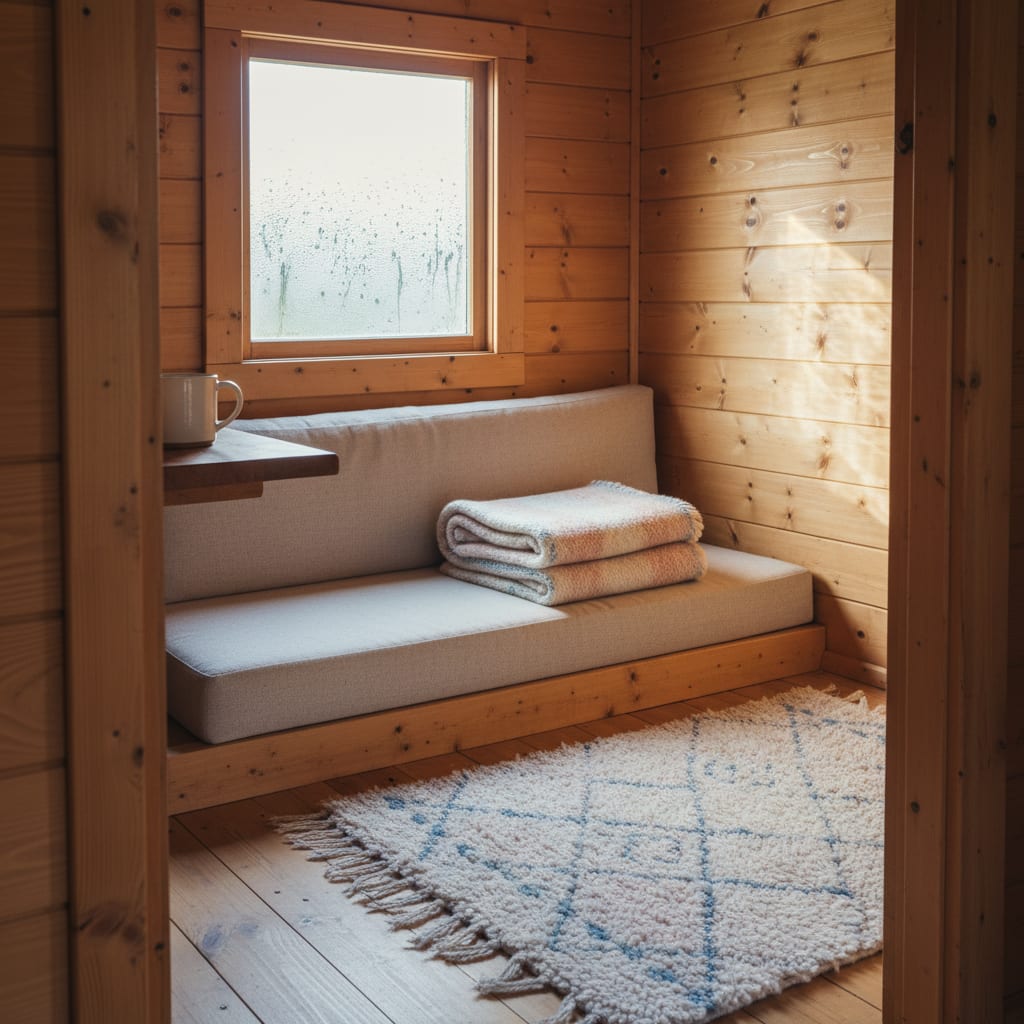
Small space, wet coats, a kettle, laundry with nowhere to go and a cold outer skin: condensation is close to inevitable, and it lands overnight on the coldest surface — usually a window by somebody’s head.
Government guidance says plainly that “Condensation is one of the most common causes of damp and mould in homes” and that “if a dwelling is inadequately ventilated, moisture in the air cannot escape.” It also says, and this is worth sticking on a cupboard door: “It is totally unreasonable to blame damp and mould in the home on ‘lifestyle choices’.” The same page flags children, “whose organs are still developing”, as more likely to suffer respiratory problems from it.
So never block a fixed vent, even on the coldest night — on a boat they are a safety feature too. Crack a roof vent instead of sealing up, wipe the windows in the morning, and dry washing away from where a child sleeps. Warm and ventilated beats hot and sealed.
The bed that is also a sofa
In a house the bed exists all day, so “we’re going to bed now” means moving somewhere else. Here the bed has to be made — a dinette dropped, cushions shifted, a board pulled out — in front of the child who is meant to be winding down.
- Make the bed before the routine starts, while they are in the bath or having a story. The conversion is the loudest five minutes of the evening and it should be over before bedtime begins.
- Move the cue from the place to the sequence. With no door, the signal cannot be “we have gone somewhere else”, so it has to be “these four things, in this order, every night” — the same trick that makes a single-parent bedtime routine work solo.
Darkness is the easier half: these windows are small and usually already have blinds, so they take a friction fit or a clipped lining well. Everything in my guide to blackout without drilling applies, on a smaller and cheaper scale.
Noise you have not had before
Rain on a metal or fibreglass roof is genuinely loud and starts without warning. So do site noises — a car door at eleven, a generator, somebody’s awning — and on a boat, water against the hull and passing engines.
Most of it settles within a fortnight, because it is constant, and children adapt to constant. What wakes them is contrast — silence, then one bang. Run something steady all night so the bang lands on a floor of sound rather than on nothing — and charge with your engine in the early evening, never at 2am.
The safety bits specific to here
- A carbon monoxide alarm is not optional. The Boat Safety Scheme says to install at least one certified CO alarm meeting BS EN 50291-2 — the standard written for boats and caravans, not the household one. Fit it where you sleep: stoves, gas fridges and engines all produce it, and a small sealed space is the worst place for it.
- The sleep surface still has to be firm and flat. Travel cot mattresses “tend to be a lot thinner than a conventional cot mattress; however, these are suitable for a main sleep space as long as they are firm, flat, in good condition and meet British Safety Standards”, says the Lullaby Trust — and “don’t place folded blankets or a quilt under the baby”, which is exactly the temptation on a hard dinette base on a cold night.
- Check for gaps. A mattress wedged into an alcove leaves a slot down one side; fill it or move the bed.
If you are cruising rather than parked
A continuous cruiser cannot stay put: the Canal & River Trust’s rule is that “you must not overstay anywhere. This generally means no longer than 14 days”. So the outside of the bedroom changes every fortnight while the inside stays identical — which is the right way round. Keep the sleep space arranged the same at every mooring, so the only thing that changes is the view. If moving becomes impossible for a while, the Trust’s welfare team can agree something in advance.
The money bit, said out loud
Almost nothing above costs anything: a thermometer, a fan you already own, ten minutes earlier on the bed conversion, a vent open instead of taped shut. The two I would spend on are the CO alarm, which is not negotiable, and a sleeping bag of the right tog, which does the job an unreliable heater cannot — same logic as the rest of my baby sleep on a budget kit list.
Give it a fortnight before deciding anything is broken; week one is usually the move, not the boat. If sleep is still coming apart after that, it is probably whatever it would have been in a house, and a short sleep quiz narrows it down faster than more guessing.
FAQ
Is it safe for a baby to sleep in a caravan or on a narrowboat?
Yes, with the same safer sleep rules as anywhere: a firm, flat mattress in good condition, nothing padded underneath, and 16–20°C. The two things specific to boats and vans are a certified CO alarm and an unblocked vent.
How do you keep it warm enough without overheating?
Aim for a steady 16–20°C and use layers rather than a heater you have to trust all night. The Lullaby Trust suggests an extra layer over running heating overnight, and no higher than 20°C if you do.
How do you do a bedtime routine with no separate bedroom?
Make the bed up before the routine starts, then lean on the sequence rather than the space. With no door, the order is what tells a child what comes next.
Will they sleep through rain on the roof?
Usually within a couple of weeks. Constant noise stops registering; sudden noise does not.