Bedtime After a Fright: Helping a Child Sleep Again
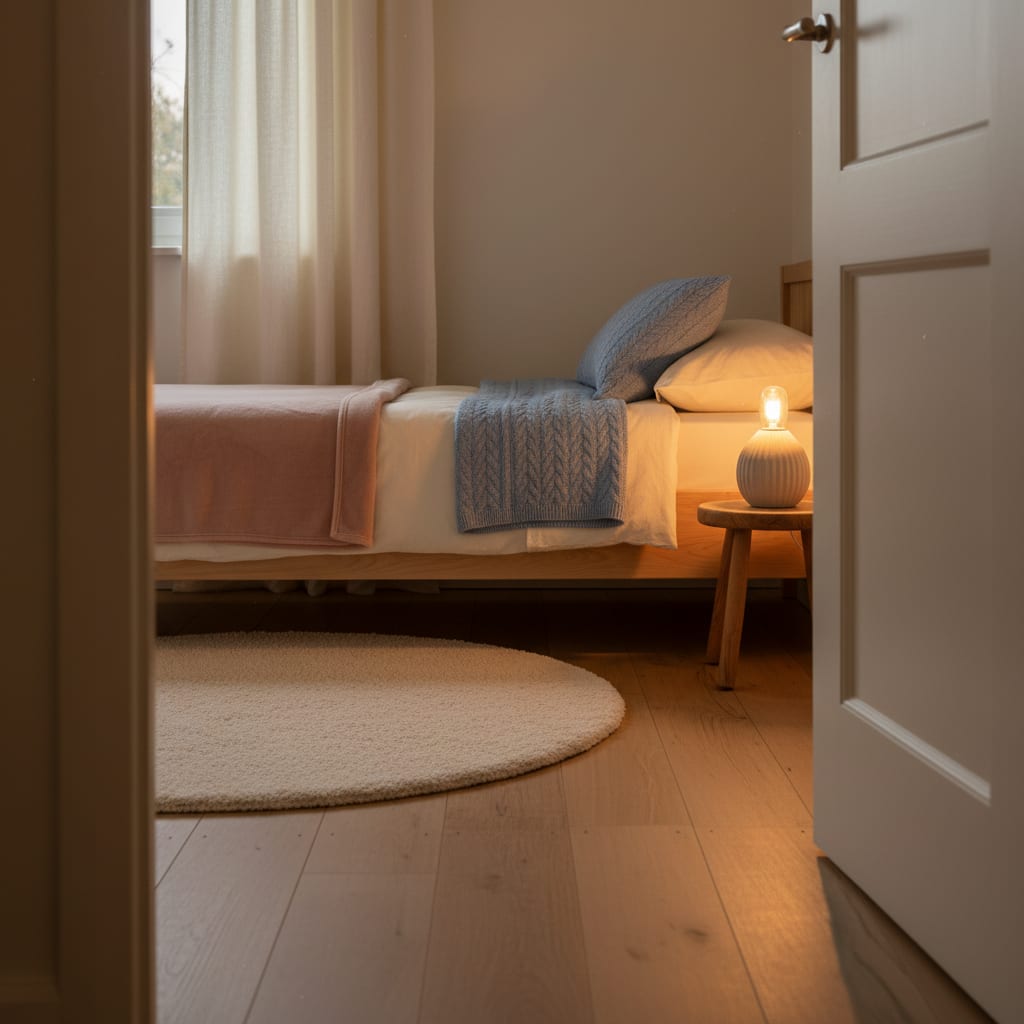
After a fright — a fall off the sofa, a nightmare, a night in A&E — the sleep problem is almost never the room. It is that being alone in the dark has stopped feeling safe, so the fix is more presence for a short, clearly-ending stretch and then a deliberate walk back to normal. Keep the bedtime you already had, add one visible piece of reassurance, and take it away again inside a fortnight. What causes lasting trouble is not the comforting; it is the comforting that quietly becomes the new arrangement.
Why a fright lands on bedtime
Bedtime is the one part of the day we ask a child to do alone, in the dark, without checking. Everything else frightening happens with you in the room. So a fright does not really break their sleep — it breaks the assumption underneath it, which is that being on their own is fine.
So the wobble rarely shows up on the night itself. It shows up three days later at 7.15pm, when the door closes — which is also why “be firm, stick to the routine” only half works. A frightened child is not stalling. They are checking.
A fall: you do not have to keep them awake
The NHS head injury guidance sets out when it is not a wait-and-see: call 999 if the child “has been knocked out and has not woken up”, has “fallen from a height of more than 1 metre or 5 stairs”, has clear fluid coming from the ears or nose, or has “problems with walking, balance, understanding, speaking or writing”. Call 111 if they are being sick or feel dizzy afterwards.
Then the line that surprises most parents, including me: you do not have to keep them awake. The NHS says plainly to “rest and avoid stress – you or your child do not need to stay awake if you’re tired”. The keep-them-up-all-night thing is folklore. What the guidance does ask is that “an adult stays with you or your child for at least the first 24 hours”.
That last sentence reads differently when you are solo: no shift system, no popping out, and you are the one who has to be awake enough to notice a change at 3am. I now make that night the easy one on purpose — everyone in one room, phone charged and loud, nothing else attempted.
A bad dream: two different events, two opposite responses
The NHS draws the line clearly. During a night terror a child “may talk and move about but are asleep”, and “it’s rare to remember having a night terror”. A nightmare is a bad dream they wake from and can remember. Night terrors are most common between the ages of 3 and 8.
- Night terror: stay calm, keep the space safe and wait it out. The advice is explicitly “do not try to wake them – they may not recognise you and may get more upset if you try to comfort them”. It is far worse to watch than to have.
- Nightmare: they are awake and they know you. Comfort, name what happened, wait until the shaking stops, then settle them in their own bed rather than yours.
The NHS also lists being very tired among the triggers, which is the loop to break early: a bad night makes an overtired child, and an overtired child has more bad nights. Speak to a GP if nightmares are still going after the age of 6, or if night terrors happen most nights.
Coming home from hospital: expect a step backwards
A day case, an overnight, a frightening A&E trip — the aftermath is often a child who seems younger than they were a week ago, and it catches parents off guard.
Great Ormond Street’s guidance for families after a difficult admission names exactly this: difficulty with sleep, nightmares, “being more clingy to parents/carers” and “temporary loss of abilities including feeding and toileting”. These “can be normal following a difficult experience, as the child is trying to make sense of what has happened”, and often resolve on their own. Keep normal boundaries, talk about it honestly and at their level, and rebuild safety with whatever comforted them before.
Its going-home advice adds the practical half: limit visitors for a few days, and “try to get back into your normal routine when you get home – go back to regular mealtimes and bedtimes”. Not a gentler routine. The same one.
The seven-night walk-back
My recurring mistake is doing too little on night one and far too much by night four.
- Keep the shape identical. Same order, same room, same time. Predictability does more work than anything you add.
- Add one thing, not five. A low light, or the door properly open, or you sitting on the floor. Five things are five things to remove later.
- Name it, with an end. “I’m sitting here tonight and tomorrow night.” Children handle a boundary they can see the edge of far better than an open-ended one.
- Move, do not stop. Night three the chair goes to the doorway, night five the landing, night seven back to normal. A bad night means repeat a step, not start again.
- Do the talking in daylight. Bedtime gives the fear the last word. Talk about the fall or the hospital at breakfast.
- Watch the bedtime itself. After a disrupted week it has usually drifted twenty minutes later, and overtiredness makes everything worse.
- Give it a fortnight. Most of it settles on its own.
If the child is a toddler and you cannot tell whether this is a fright or a schedule that has slipped, Betteroo’s step-by-step toddler bedtime routine is worth holding your own up against — and if it has become a child who keeps getting back out again, that particular pattern has its own answers.

Doing it with nobody to tap in
Every version of “take it in turns” assumes turns exist. Solo, the cost is not the comforting — it is that there is no recovery night. Two people can each have a broken night and then a whole one; you get seven in a row, and by night four your judgement about what is reasonable has gone. Three things that make it survivable:
- Decide the plan while you are rested. Write the seven nights down on a Sunday afternoon; at 11pm on Wednesday you will not be capable of deciding anything. Same reason I keep a written single parent bedtime routine rather than improvising.
- Sleep in their room, not in your bed. A folded duvet on their floor for two nights is far easier to stop than a fortnight of co-sleeping.
- Lower everything else — beans on toast, no washing, bedtime at seven. Same logic as keeping a routine through a cold: protect one thing, let the rest slide.
The small things that help, and what they cost
- A torch by the bed, a couple of pounds (~$2.60), which hands the control over and beats any nightlight.
- The door open a measured amount — not “a bit”, an actual same-every-night amount.
- A dim plug-in nightlight, somewhere around £5 to £10 (~$6.50–$13), rather than the big light. Put the room back on a good night rather than a bad one, one variable at a time — much like any other school-night bedtime reset.
FAQ
How long is a child usually scared to sleep alone after a fright? Days to a fortnight, worst in the first week. Something still going strong after two or three weeks, or getting worse rather than better, is worth raising with a health visitor or GP.
Do you have to keep a child awake after they bang their head? No. The NHS says explicitly that you do not need to stay awake if you are tired. It does advise that an adult stays with them for the first 24 hours, and that you call 999 or 111 for the warning signs above.
My child was fine at the time and is scared a week later. Is that normal? Very. The reaction often arrives late, once there is space to think about it. Treat it as the same fright, delayed, and use the same plan.
Should I let my child sleep in my bed after a scare? A night or two will not ruin anything, but it is much harder to reverse than sitting in their room.